
Agentic AI for Data Management: 7 Ways It Transforms Business Operations
Table of Contents
What is the Role of Agentic AI for Data Management?
Can Autonomous Data Operations Really Make An Impact?
How Can Data Automation Solutions Help Organizations?
Know the Key Features
How Traditional and Modern Agentic AI Are Different?
Tips for Adopting AI Agents Efficiently
Top Intelligent Data Governance Platforms Compared
Why NeuroDextra Is Better?
NeuroDextra Vs Other AI Powered Data Management Platforms
Conclusion
Frequently Asked Questions (FAQs)
Sometimes, restricted access to critical insights, compliance and governance risks, and low visibility into market data can create hurdles when compiling data and achieving a comprehensive view of operations on a single platform. Agentic AI for data management can help address such challenges by ensuring data quality, forecasting trends, driving data-driven decisions, and suggesting resource allocation strategies.
Businesses manage vast amounts of data spread across multiple platforms, including CRM systems, cloud environments, and spreadsheets, making data management increasingly complex. Instead of fragmented data, predefined workflows, and higher operational costs, organizations can explore business opportunities and transform existing data management.
According to Gartner, the global Agentic AI market has reached $10.86 billion, highlighting the growing demand for AI systems capable of making decisions and performing tasks autonomously. Approximately 62% of organizations are still learning to use AI agents and integrate them into their future projects.

In this blog, we will learn how Agentic AI for data management works, how it can streamline business operations, why it is important, and which platforms organizations can rely on.
Ready to transform your data management process? NeuroDextra can help.
What is the Role of Agentic AI for Data Management?
It is a specialized system that:
· Makes the process of optimizing data workflows easier
· Ensures seamless real-time adaptation
· Helps organizations discover, govern and optimize data workflows

· Works through self-learning and real time adaptation
· Detects compliance issues
· Generates key data insights faster
The reason Agentic AI for data management is being adopted by enterprises and organizations worldwide is that solve common problems and challenges that often come with traditional data tools.
It understands the context of a business, regardless of its size or type, and takes automated actions to fix issues, delivering quality and consistency in data, reports, and analytics.
Can Autonomous Data Operations Really Make An Impact?
Whether it’s content generation, automating simple tasks or analyzing data, AI is evolving at a rapid rate. Agentic AI is at a whole new level. It can act independently and make data-driven decisions by evaluating results.
From creating an accurate data report to analyzing sales numbers, identifying errors, and developing a retention strategy, Agentic AI for data management can do it all. Such activities can happen on their own without any hassle in less time.

The same autonomous, real time decision making is showing up in advertising too, see our piece on Facebook advertising automation.
How Can Data Automation Solutions Help Organizations?
This builds on the foundational shift we cover in intelligent data management platforms.
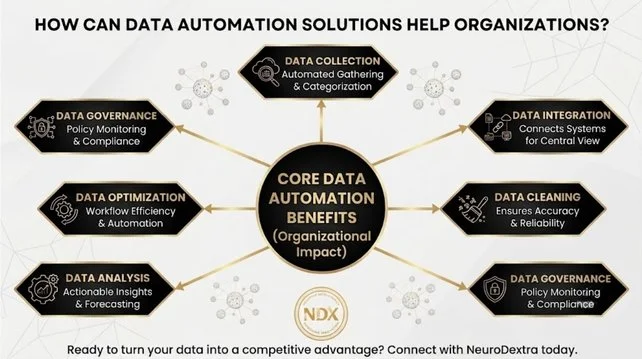
AI intelligence platforms help organizations by performing the following tasks:
Data Collection
Organizations generate tons of data every day. This data can come from various sources, such as websites, customer information, sales data, social media, mobile apps, or third-party databases. The data intelligence solutions eliminate the manual effort and time taken to extract data and analyse it. It can continue to monitor, collect relevant information, and categorize it, allowing the user to access the latest data.
Data Integration
After data collection comes another challenge: Integrating data from various sources. When organizations store their data across multiple systems, getting a comprehensive view of it can be challenging sometimes. Agentic AI for data management simplifies data management by connecting all such systems to integrate data. When an organization have a centralized view of all the data and numbers, it can enhance its team’s productivity and make decisions quickly.
Data Cleaning
Data cleaning, in simple terms, means ensuring that the gathered data is accurate and complete, with no missing entries or duplicates. Such issues can lead to incorrect data entries and invalid data fields. The data automation platform detects such anomalies, thus ensuring data accuracy and trust in reporting.
Data Analysis
Using Agentic AI for data management means the user no longer needs to wait for data reports or spend hours monitoring key metrics. It automatically performs such tasks with complete ease and produces actionable insights. From analyzing changes in sales performance to anticipating emerging market opportunities, it provides the insights organisations need to be more proactive.
Data Optimization
Want to use key data insights for driving business growth? Data optimization can help. The Agentic AI architecture is designed to evaluate processes, uncover workflow inefficiencies, and automate repetitive tasks. These kinds of improvements help organizations maximize the value of their data assets.
Data Governance
Organizations need to ensure their data remains secure, safe and compliant with the industry regulations. Agentic AI for data management can deal with large datasets by monitoring data policies and enforcing compliance rules. It also ensures governance standards are followed throughout the organization.
Ready to turn your data into a competitive advantage? Connect with NeuroDextra today.
Know the Key Features
Autonomous Data Discovery
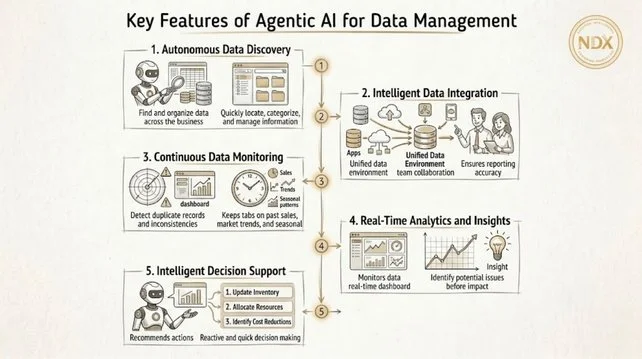
A major benefit of AI is that it can find and organize data across the business. Instead of employees spending hours searching through databases, spreadsheets, and applications, AI agents can quickly locate, categorize, and manage information.
Intelligent Data Integration
Agentic AI for data management brings data together into a unified environment and helps teams to collaborate effectively. It further enhances data accuracy and ensures reporting is based on up-to-date information.
Continuous Data Monitoring
AI continuously monitors data quality across systems to ensure information remains reliable and trustworthy. It helps detect duplicate records, inconsistent formats and outdated information. It also keeps tabs on past sales data, current and upcoming market trends, and seasonal patterns.
Real Time Analytics and Insights
Agentic AI for data management monitors data quality. This means organizations no longer need to rely on manual audits and can identify potential issues before they can even impact business operations.
Intelligent Decision Support
Intelligent data governance platforms recommend actions such as updating inventory, allocating resources, and identifying cost-reduction opportunities. This can lead to reactive and quick decision making.
How Traditional and Modern Agentic AI Are Different?
Tips for Adopting AI Agents Efficiently
Evaluate your organization's current capabilities
Train your team and prepare them to work with AI agents
Select Agentic AI for Data Management platform according to your business needs
Understand the role and features of AI agents
Top Intelligent Data Governance Platforms Compared
Traditional data management tools often require significant human intervention and cannot keep pace with the growing complexities. Teams spend valuable time searching for information, fixing data errors, and managing workflows instead of focusing on strategic initiatives. So, why not choose the right one?
Here is a list of the top 5 leading Data Management platforms:
1. NeuroDextra
NeuroDextra is built to automate workflows and streamline the entire reporting system. This Agentic AI for Data Management takes a business-first approach by integrating AI implementation, reporting systems, and intelligent business operations. It can be easily integrated with existing business systems. The platform emphasizes business outcomes and enables scalable AI transformation. It offers a more comprehensive approach by integrating intelligent automation, data management, and business transformation together.
Best For: Organizations that are planning to transform their businesses, rather than relying on the usual data management tools.
Key Strengths:
Workflow automation
AI-powered reporting systems
Enterprise AI integration
Custom AI agents
Long-term strategic support
2. Acceldata ADM
Acceldata's Agentic Data Management platform utilize AI agents to monitor large-scale enterprise data environments and pipeline failures. It enables organizations to build custom AI agents tailored to their specific business needs and automate data management processes, helping data engineering teams efficiently manage complex data architectures.
Best For: Large scale organizations and enterprises dealing with complex data infrastructure.
Key Strengths:
Data observability
AI-driven anomaly detection
Custom agent development
Enterprise scalability
3. DQLabs
This Agentic AI for data management automates data profiling, metadata management, and data quality monitoring, helping organizations maintain accurate, consistent, and reliable data across their systems. It monitors pipelines, assesses quality, and recommends actions through AI-powered agents.
Best For: Organizations that need a reliable tool to ensure data quality.
Key Strengths:
Automated data management
Real-time results
AI readiness support
Data reliability
4. Exterro
Exterro focuses primarily on data governance, compliance, privacy, and risk management. This Agentic AI for data management is ideal for users who prioritize protecting sensitive information and complying with regulatory requirements. This can streamline operations in industries that heavily rely on data security and compliance. It reduces risk and primarily focuses on business process automation.
Best For: Compliance-only organisations.
Key Strengths:
Privacy management
Compliance automation
Risk monitoring
Legal operations
5. Astera
Astera uses conversational AI and agentic workflows to make enterprise data operations more accessible. It is easy to use, creates data pipelines, and prepares datasets to execute workflows seamlessly.
Best For: Organizations that need low-code data management.
Key Strengths
Conversational data operations
Unified data lifecycle
Workflow automation
Faster deployment
Why NeuroDextra Is Better?
The Agentic AI for data management helps organizations manage data. The platform recommends actions and automates workflows. It is built around autonomous AI agents that limit human intervention and connect data management with business process automation.
It can also be tailored to specific business needs through workflows and industry-specific solutions. It offers flexible features and functions which means the industrial workflows and improvement recommendations can be customized according to the specific business needs.
NeuroDextra Vs Other AI Powered Data Management Platforms
Conclusion
Agentic AI for Data Management is the way to transform data sets into informative and valuable business assets that can change the way organizations used to make data-based decisions. When it comes to enhancing operational performance, the data automation solutions can help with data quality, governance, and compliance. Here comes- NeuroDextra.

NeuroDextra helps businesses transform how they get work done across all departments. It offers AI platforms for workflow automation, AI assistants, integrations, and strategic implementation if you are looking to reduce manual work and build scalable, AI-driven workflows. Connect with NeuroDextra.
FAQs
1. What do you understand by Agentic AI?
Agentic AI for data management is a multi-agent autonomous system that uses AI agents to automate tasks such as collecting, organising, and monitoring data. It works independently perform tasks and helps organizations make decisions faster.
2. Is Agentic AI different from traditional AI?
Traditional AI platforms are designed to perform specific tasks when given the right instructions. On the other hand, Agentic AI do more than automate tasks. It helps the user make data-driven decisions, take action, drive outcomes, and streamline workflows.
3. What problems can Agentic AI solve in data management?
Agentic AI can tackle common challenges such as poor data quality, data silos, compliance issues, slow reporting processes, and delayed decision-making.
4. Can Agentic AI help with data governance and compliance?
Yes. Agentic AI for data management can strengthen data governance by managing user access, monitoring sensitive data, enforcing policies, and ensuring compliance across data environments.
5. Does Agentic AI replace data analysts and data engineers?
No. Agentic AI can readily support data professionals by automating a range of tasks. It helps save an organization’s time and resources, allowing professionals to focus on strategic planning, identify opportunities, and leverage advanced analytics for business growth.
6. How does Agentic AI support better decision-making?
The role of agentic AI for data management is to analyze and monitor data in real time. This further helps organizations identify key trends, prepare for possible market changes and make changes to their current strategies.
7. Can Agentic AI integrate with existing business systems?
Yes. Agentic AI platforms can integrate with existing systems, including CRM systems, cloud databases, and operational systems. This enables organizations to easily enhance their work processes without incurring high costs for existing technology infrastructure.
8. How can businesses measure the ROI of Agentic AI for Data Management?
The best way for organizations to measure ROI is to track key outcomes such as improved operational efficiency, lower costs, faster reporting processes, enhanced data quality, and increased revenue.
