
TL;DR: If orders, inventory and job costs live in spreadsheets and nobody agrees on the numbers, this guide shows how to choose an ERP that fits your shop and prepare your data so the rollout works. Want help choosing and automating around it? Book a free call.
Table of Contents
If you have ever walked a shop floor with a clipboard, trying to match a customer order against what is actually on the shelf, what is half finished on a machine, and what a supplier promised for Thursday, you already know the problem ERP exists to solve. Information about the same job lives in the quoting spreadsheet, the purchasing inbox, the accounting package, and somebody's memory, and none of them agree.
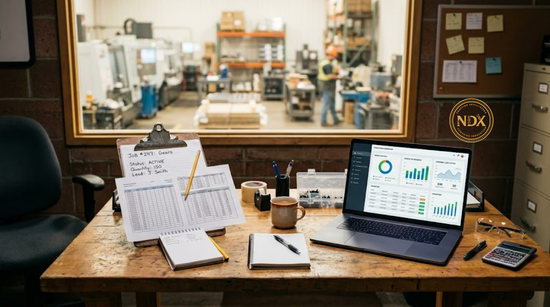
Choosing the best ERP for small manufacturing business owners is harder than it should be, because most of what you find online is written by vendors, and every vendor is the best option for somebody. This guide takes a different approach. It covers what ERP software for manufacturing actually does, why so many projects miss their goals, what real manufacturers say in public discussions, and how to choose without paying for features you will never use.
The category is not small. According to Fortune Business Insights, the global ERP software market was valued at 92.6 billion dollars in 2025 and is projected to grow from 106.22 billion dollars in 2026 to 281.58 billion dollars by 2034, a compound annual growth rate of 13 percent, with North America holding 34.20 percent of the market in 2025. Estimates vary by research firm, but growth like this suggests ERP is no longer a conversation reserved for large plants. Not sure which direction fits your shop? Book a free call and we will walk you through it.
What Is ERP Software for Manufacturing, Really?
Strip away the jargon, and ERP software for manufacturing is one shared system of record for the whole operation:
Bills of materials, routings, and production orders in one place
Inventory, purchasing, and supplier information tied directly to those orders
Finance and job costing that update as work happens instead of at month end
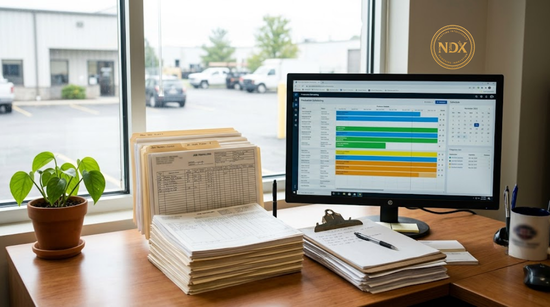
ERP grew out of material requirements planning, or MRP. MRP answers a narrow question: what do we need to buy, and when, to build what we have promised. ERP wraps that logic in finance, sales, purchasing, and reporting, so the answer to that question is connected to what it costs and what has already been sold. For a small manufacturer, that connection is the whole point.
Not sure what you actually need from an ERP? Book a free call and we will map your jobs with you.
Why Small Manufacturers Struggle to Choose
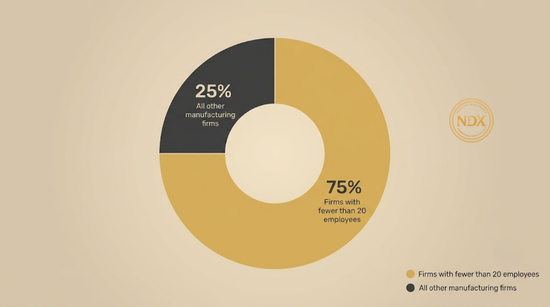
Small manufacturers are the norm, not the exception. According to the National Association of Manufacturers, the vast majority of manufacturing firms in the United States are small, meaning fewer than 500 employees, and about three quarters of them have fewer than 20. A team of that size rarely has a dedicated IT department, which means the person evaluating ERP is usually the owner or an operations manager doing it alongside a full time job.
Here is the honest version, because ERP gets oversold constantly. Buying one is not the finish line. Gartner's research predicts that by 2027, more than 70 percent of recently implemented ERP initiatives will fail to fully meet their original business goals. That is not the same as saying 70 percent of projects get scrapped. It means the business case that justified the purchase was not fully realized. Gartner points to technology centric approaches that ignore stakeholder engagement as a common cause, and to alignment between the ERP initiative and corporate strategy as one of the top predictors of success.
For a small manufacturer, that translates into a practical rule: the clearer you are about the problems you want solved, the less likely you are to buy a system built for someone else's problems. And if AI features are part of the pitch, it is worth understanding how much they depend on clean, connected data first, which we cover in our breakdown of agentic AI for data management.
Worried about joining the projects that miss their goals? Book a free call before you buy anything.
What the Right ERP Actually Does for a Small Manufacturer
Connects Quotes, Orders, and Production in One Flow
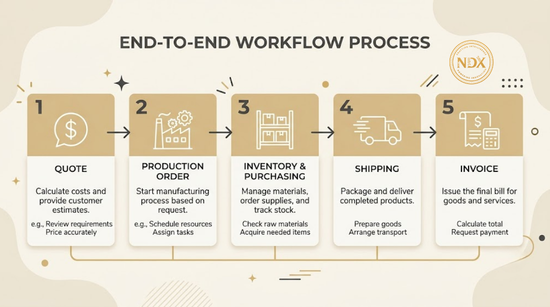
Instead of retyping a customer order into a scheduling sheet and then again into the accounting system, the same record moves from quote to production order to shipment.
Keeps Inventory Honest
Counts update as materials are received, consumed, and shipped, so the number on screen is the number on the shelf, not the number from last month's cycle count.
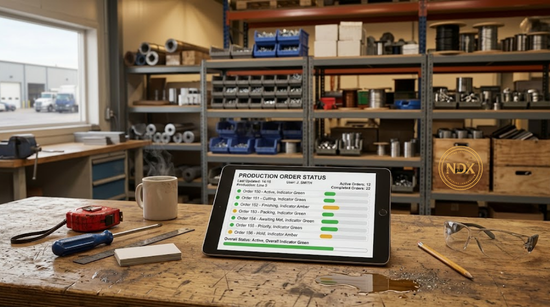
Plans Materials Against Real Demand
MRP logic compares open orders against stock and supplier lead times, so purchasing is driven by what is actually needed rather than by habit or a gut feeling about what might run short.
Shows Real Job Costs
When labor, materials, and overhead are captured against each job, pricing conversations start from real numbers. Many small shops are surprised by how different their actual costs are from their assumptions.
Tracks Suppliers and Lead Times
A late supplier delivery is a scheduling problem, not just a purchasing one. When purchase orders are connected to production orders, the impact of a delay is visible immediately.
Gives the Office and the Floor the Same Numbers
Disagreements about what is in stock or what is due this week usually come from two groups working from two versions of the truth. One shared system removes the argument.
Supports Traceability and Reporting
Lot tracking, job history, and reporting that customers and auditors ask for become a query instead of a scramble through folders, depending on the system you choose.
Want to see how this would work for your products? Book a free call.
The Features That Matter Most
Bill of materials and routing management that matches how your products are actually built, including the awkward ones with custom options.
Production scheduling and MRP that reflects real capacity and real supplier lead times, not idealized ones.
Inventory control with lot or serial tracking if your customers or regulators expect it.
Job costing that captures labor and materials per job so margin is visible while a job is still running.
Integrations with accounting, ecommerce, shipping, and CRM tools you already use, so the ERP becomes the hub rather than another island.
Usability for a small team. A system that only one trained person can operate is a risk, not an asset.
Thinking about what this would look like built around your own products and tools? Book a free call.
Spreadsheets vs an ERP Approach
| Area | Spreadsheets and Disconnected Tools | ERP Approach |
|---|---|---|
| Order to Production Flow | Retyped between systems | One record end to end |
| Inventory Accuracy | Updated manually, drifts over time | Updated as materials move |
| Material Planning | Based on habit and memory | Driven by open orders and lead times |
| Job Costing | Estimated after the fact | Captured per job as work happens |
| Reporting | Assembled by hand | Available on demand |
| Dependence on One Person | High | Lower, process lives in the system |
Still on spreadsheets and not sure when to switch? Book a free call.
What Manufacturers Are Actually Arguing About
Search this topic and Google puts Reddit on the first page, and the threads behind those results are more revealing than most vendor pages. Read enough of them and three arguments keep coming back.
Does the ERP deliver, or do you pay again to patch it?
In one r/manufacturing thread, a poster asks why companies keep spending on custom fixes if ERP is supposed to be the backbone. By the poster's own unverified account, a friend's large rollout was meant to do everything, yet within a year another 120,000 pounds went into custom automation to make procurement workable. The gaps listed are small and familiar: bills of materials uploaded by hand, customer purchase orders retyped because the ERP cannot read them, and supplier chasing done through reminder emails instead of the system. The thread ends by asking whether any ERP has delivered the whole promise.
In another thread asking whether any ERP actually works well, a top reply gives a more balanced answer: most systems work fine, and how well they work depends on the quality of the data going in and the discipline to keep it clean.
Big systems feel like overkill, small tools miss the compliance side
A food and beverage manufacturer asking what others run describes the squeeze well: spreadsheets only get you so far, the big ERP systems feel expensive and often overkill, and the smaller tools do not always handle recalls, audits, or lot tracking. In another thread, someone at a 20 to 30 person assembly manufacturer says the product they have used for ten years, built for injection molding companies, has become very limiting, and that they want to avoid a system that needs development resources they do not have.
Does the ERP belong on the shop floor, and will anyone use it?
In a thread asking whether any ERP makes day to day manufacturing easier, a top reply argues that ERPs do not really work on the shop floor, that this is what a manufacturing execution system, or MES, is for, and it is skeptical of MES add ons sold by ERP vendors. An older r/engineering thread shows the same tension: the poster’s company chose a system partly because finance needed it, but the MES was not integrated, so some work was being duplicated. Adoption is the other half of the story. A small manufacturer in a recent r/InventoryManagement thread says their team failed to use an ERP they tried, with blame passing back and forth between teams.
What this adds up to
These are individual posts, not research, but the pattern is consistent. The complaints are rarely about a missing feature. They are about the gaps around the system: manual handoffs between tools, data nobody maintains, add ons that do not talk to each other, and rollouts nobody owns. That lines up with the Gartner forecast discussed earlier, where projects miss their goals when stakeholders are ignored and strategy is unclear, not because the software lacks features.
The conversation is also shifting. Results pages for this topic now often open with an AI Overview, and some vendors describe their products as AI native ERP. New features do not rescue an unclear brief, so the practical takeaway for a small manufacturer is to decide what you need ERP to fix before deciding how much AI you want in it.
How We Approach It
Each argument has a practical answer. For the patching problem, scope the automation around the ERP up front, covering bill of materials intake, purchase order capture, and supplier follow ups, instead of discovering the gaps after go live. For the size problem, select against a scorecard that weights traceability and compliance alongside what a small team can realistically implement. For the data problem, clean and prepare records before migrating them. And for adoption, name an internal owner and involve the people on the floor early. That is the work NeuroDextra does around whichever system a manufacturer picks.
Seen these problems in your own shop? Book a free call and we will go through them.
If You Are Choosing One, Start Here
Map how a job moves from quote to shipment before you look at a single vendor. The map becomes your requirements.
Write down the three problems you most need solved. A tight scope protects you from paying for features you will not use.
Clean your data first. Duplicate parts, inconsistent units, and outdated supplier records migrate faithfully into a new system and become a new problem. Our guide to the intelligent data management platform covers what good preparation looks like.
Shortlist two or three options and ask each to demonstrate one of your real jobs, not their sample data.
Ask for the full cost picture: licenses, implementation, training, integrations, and ongoing support. Many manufacturing ERP vendors quote pricing per customer rather than publishing it.
Name an internal owner and plan for change. Gartner points to ignored stakeholders as a leading reason projects miss their goals, and on a small team, that stakeholder is the person on the floor who has to use it.
Want a second pair of eyes on your requirements before you talk to vendors? Book a free call.
Best ERP for Small Manufacturing Business Options, Compared
There is no shortage of systems claiming to be the right fit for small manufacturers. Here is how five approaches compare.
NeuroDextra
NeuroDextra takes a business first approach to ERP. It is not an ERP vendor, which is the point. It helps small and mid sized manufacturers choose without a vendor's sales agenda, clean and migrate their data, and build the automation around whichever system they select, tailored to how the shop actually runs rather than a one size fits all template.
Best for: manufacturers who want vendor neutral guidance and custom automation connected to their existing tools, not just a software purchase.
Strengths: vendor neutral selection support, data cleanup and migration preparation, custom workflow automation around the chosen ERP, ongoing strategic support.
Want a vendor neutral view of which option fits your shop? Book a free call.
NetSuite
Oracle's cloud ERP, widely used by growing and mid sized companies that want one platform across finance, inventory, and manufacturing.
Best for: growing manufacturers ready for a broad cloud platform and a larger implementation.
Acumatica
A cloud ERP with a manufacturing edition, commonly positioned for small and mid sized businesses that expect to grow.
Best for: growing manufacturers who want a cloud system with room to expand.
Odoo
A modular, open source based platform where manufacturing is one app among many, popular with small businesses that want to start with a few modules.
Best for: companies with some technical capacity or an implementation partner.
Katana
A cloud platform built around inventory and manufacturing for small product businesses, commonly paired with online sales channels.
Best for: small makers selling through ecommerce channels.
Why NeuroDextra Stands Out
Production, inventory and costing are standard features across ERP systems, so the real differences are elsewhere. What sets NeuroDextra apart is the work around the software: an unbiased view of which system fits, data that is ready before migration, and automation built around how your shop really works. Gartner links ERP success to strategic alignment and stakeholder engagement, and that surrounding work is where projects are won or lost.
Head to Head Comparison
| Capability | NeuroDextra | NetSuite | Acumatica | Odoo | Katana |
|---|---|---|---|---|---|
| Vendor Neutral ERP Selection Guidance | Strong offering | Not Primary | Not Primary | Limited focus | Not Primary |
| Custom Workflow Automation Around Your ERP | Strong offering | Selected Service | Selected Service | Selected Service | Limited focus |
| Data Cleanup and Migration Preparation | Strong offering | Selected Service | Selected Service | Limited focus | Limited focus |
| Integration With Existing Business Systems | Strong offering | Selected Service | Selected Service | Selected Service | Selected Service |
| Ongoing Strategic Support | Strong offering | Limited focus | Limited focus | Limited focus | Not Primary |
Want to see what a vendor neutral ERP selection and automation plan looks like for your shop? Book a free call with NeuroDextra.
FAQs
What is the best ERP for small manufacturing business owners?
There is no single answer, because the best system depends on how your products are built and what tools you already use. Cloud platforms such as NetSuite or Acumatica suit growing manufacturers, while Odoo or Katana can suit smaller teams. A scorecard built from your own jobs usually decides it better than any ranking.
Which ERP software is best for manufacturing?
The one that matches your process, your data, and your team's capacity to adopt it. Gartner links ERP success more strongly to strategic alignment than to any specific technology, so start with the problems you need solved.
What are ERP systems for manufacturing?
They are software platforms that connect production, inventory, purchasing, and finance in one shared record, so quotes, orders, materials, and costs stay consistent instead of living in separate spreadsheets.
What is the difference between ERP and MRP?
MRP plans materials and production against demand. ERP includes that planning and adds finance, sales, purchasing, and reporting around it, so the plan is connected to cost and revenue.
Is there a free ERP for small manufacturers?
Open source options exist, and some vendors offer free tiers or trials. The software license is rarely the main cost though. Implementation, data preparation, training, and support usually matter more, so compare the total picture.
How do we know if an ERP is actually working?
Track whether inventory counts match the shelf, whether job costs are visible while a job is still running, and whether the office and the floor are working from the same numbers. If people still keep side spreadsheets, something is off with the setup, not the concept.
Still have questions? Book a free call and ask us directly.
Conclusion

The best ERP for small manufacturing business owners is not the one with the longest feature list. It is the one that fits how your shop actually runs, starts from clean data, and is owned by someone inside the company. Get those three things right and most of the software choices become much easier.
NeuroDextra builds this around how your operation actually works, not a generic template. If choosing the right ERP and automating around it sounds useful, Book a free call.
