
ACA Compliance Software for Employers: 7 Ways It Cuts Penalty Risk
Table of Contents
What Is ACA Compliance Software for Employers, Really?
Why Manual ACA Tracking Keeps Failing Employers
What ACA Compliance Software Actually Does
The Features That Matter Most
Manual ACA Tracking vs an Automated Approach
What a Real Filing Error Actually Costs
If You Are Adopting One, Start Here
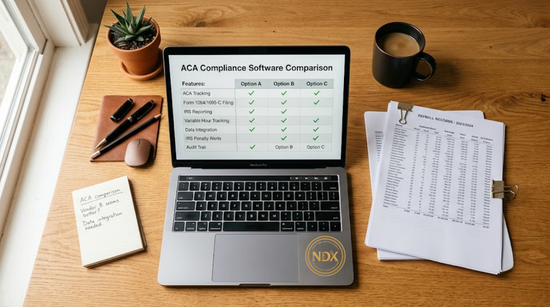
ACA Compliance Software for Employers, Compared
Why NeuroDextra Stands Out
FAQs
If you have ever spent a quarter manually cross checking payroll hours against benefits eligibility, only to find out months later that a coding mistake on a single form put a thousand employees at risk, you already understand why ACA compliance has a reputation for being unforgiving. The rules themselves are not complicated to state. Applying them correctly, every month, across every employee, is where things go wrong.

That is exactly what ACA compliance software for employers exists to fix. Instead of reconstructing full time equivalent status and coverage data by hand each filing season, the system tracks it continuously, so the numbers that go on a Form 1095-C are accurate the first time, not discovered as a liability years later.
This is not a minor administrative task anymore. According to Fortune Business Insights, the global HR software market was valued at 26.21 billion dollars in 2026
and is projected to reach 66.70 billion dollars by 2034, a compound annual growth rate of 12.38 percent, with growing regulatory compliance requirements specifically cited as a driver pushing organizations toward advanced HR software for documentation, reporting, and audit management.
We will get into what these platforms actually do, what a real filing error reveals about the risk of getting this wrong, and which options are worth a serious look.
Curious what this could look like for your organization? NeuroDextra can walk you through it.
Nothing in this article is tax or legal advice. ACA employer mandate rules are complex and penalty exposure depends on your specific circumstances, consult a qualified benefits or tax advisor for your organization.
What Is ACA Compliance Software for Employers, Really?
Strip away the vendor language, and it comes down to three things done continuously instead of once a year:
Tracks full time equivalent status monthly, using actual hours worked, not a one time estimate
Syncs payroll and benefits data so eligibility, enrollment, and coverage offers stay consistent across systems
Generates and files Forms 1094-C and 1095-C with the correct codes based on what actually happened, not a guess
The distinction that matters is ongoing versus seasonal. A once a year scramble to assemble 1095-C data only catches problems after the forms are already filed. A system tracking this monthly catches a coding mismatch or an eligibility gap while there is still time to fix it, not after the IRS sends a letter.
Why Manual ACA Tracking Keeps Failing Employers
Here is the honest version, because "ACA compliance" sounds like a once a year filing task until you actually look at what it requires. What automation does reliably is keep payroll hours, benefits eligibility, and coverage offers synchronized continuously, instead of reconciling them by hand right before a deadline.
According to the IRS's own guidance, the agency's Letter 226-J process is triggered by a data mismatch: a full time employee received a premium tax credit for marketplace coverage in a month when the employer's own Form 1095-C indicates coverage was not offered, was not affordable, or did not meet minimum value. The IRS is not investigating intent at this stage. It is comparing two data sets it already has on file and proposing a number.
That number has gotten larger. Under the IRS's 2026 inflation adjustments, the penalty under Section 4980H(a), for failing to offer coverage to substantially all full time employees, is 3,340 dollars per employee after excluding the first 30. The penalty under Section 4980H(b), for coverage that is offered but unaffordable or below minimum value, is 5,010 dollars per affected employee. Both apply monthly, and both are calculated using the employer's own filed forms as the starting point for the IRS's determination.
This overlaps closely with the same continuous versus periodic gap we cover in our breakdown of compliance reporting software, the underlying pattern shows up across every regulated area, not just ACA reporting specifically.
What ACA Compliance Software Actually Does for a Business
Tracks FTE Status Monthly, Automatically
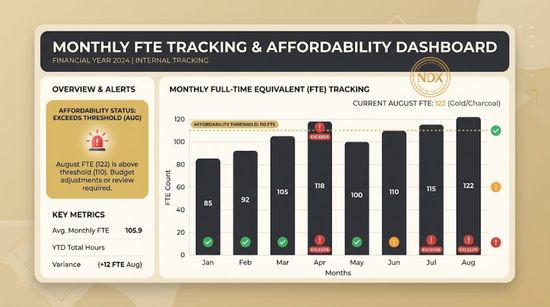
Instead of calculating full time equivalent status once a year from a spreadsheet, the system tracks actual hours worked month by month and flags when an employee crosses the eligibility threshold.

Syncs Payroll and Benefits Data in Real Time
When payroll and benefits systems do not talk to each other, data gets reconciled manually and inconsistencies slip through. Automated syncing keeps both systems reflecting the same reality continuously.
Catches Coding Errors Before Filing, Not After
A mismatched code on a 1095-C, like one indicating coverage was not offered when it actually was, is exactly the kind of error that triggers an IRS letter years later. Automated validation catches this before the form is ever filed.
Flags Affordability Issues as Contribution Rates Change
The affordability threshold changes every year, 9.96 percent of household income for 2026, up from 9.02 percent in 2025. A system tracking this automatically flags when a plan's cost threatens to cross that line before it becomes a penalty.
Generates Audit Ready Documentation on Demand
Instead of reconstructing proof of coverage offers and eligibility determinations when a Letter 226-J arrives, the documentation already exists in a format ready to support a response.
Reduces the Manual Workload of Cross Checking Systems
Chasing payroll exports, reconciling enrollment records, manually counting hours for variable hour employees, none of it needs to happen by hand every filing season anymore.
Turns Compliance Data Into Actual Risk Visibility
Beyond passing the next filing deadline, this data shows HR and finance leadership exactly where eligibility gaps or affordability risks are concentrated, before they become a six figure proposed penalty.
The Features That Matter Most
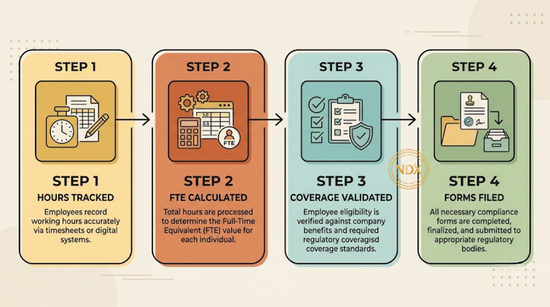
Continuous FTE tracking that calculates eligibility monthly from actual hours, not a periodic manual estimate that goes stale.
Automated payroll and benefits sync, so eligibility and coverage data stay consistent without manual reconciliation between systems.
Pre filing validation that catches coding errors and mismatches before forms are submitted, not after a letter arrives.
Audit ready documentation that generates on demand instead of requiring weeks of reconstruction once a filing is questioned.
Thinking about what this would look like for your organization's specific headcount and systems? NeuroDextra can talk you through it.
Manual ACA Tracking vs an Automated Approach
| Feature | Manual Tracking | Automated Approach |
|---|---|---|
| FTE Calculation | Annual estimate, error prone | Continuous, based on actual hours |
| Data Consistency | Manually reconciled across systems | Synced automatically |
| Error Detection | Found after filing, sometimes years later | Caught before filing |
| Affordability Monitoring | Checked periodically | Flagged in real time as thresholds shift |
| Audit Response Time | Weeks of reconstruction | Documentation ready on demand |
| Penalty Exposure | Higher, errors compound silently | Lower, caught early |
What a Real Filing Error Actually Costs
The gap between a small coding mistake and a significant penalty exposure is not theoretical. In a recent thread on r/humanresources, an HR professional described discovering that prior year 1095-C filings for roughly 1,000 employees had been processed using code 1F, which indicates the employer did not provide minimum value coverage, when appropriate coverage had actually been offered. The error spanned several years of filings, and the person was now preparing to present the risk to executive leadership while anticipating questions about audit likelihood.
A single mismatched code, applied across a thousand employees over multiple years, is exactly the kind of error that a continuous validation system catches before filing rather than years later during a documentation review.
A separate, detailed breakdown shared in r/Paychex_Official on 2026 ACA reporting deadlines lays out exactly where employers tend to get stuck operationally: keeping payroll and benefits data synced when they live in separate systems, and tracking hours accurately for hybrid or remote workforces where inconsistent time tracking leads directly to FTE miscounts. The post closes by asking employers how they're actually handling ACA reporting, in house or through a service, a question that gets at the real operational gap most compliance failures trace back to.
Put the real filing error alongside the documented operational pain points, and the pattern is consistent. The forms themselves are not the hard part. Keeping the underlying data accurate and synchronized, continuously, across systems that were not built to talk to each other, is where ACA compliance actually breaks down.
If You Are Adopting One, Start Here
Audit your existing 1095-C filings for coding accuracy before automating anything new. Automation on top of inaccurate historical data does not fix past exposure.
Confirm your payroll and benefits systems can actually sync, or plan for the integration work upfront rather than discovering the gap later.
Build in monthly FTE review, not an annual calculation, especially if you have hybrid, remote, or variable hour employees.
4. Keep documentation of every coverage offer and eligibility determination as it happens, exactly what a Letter 226-J response requires.
5. Start the review process in Q3 or Q4, not in the weeks before the filing deadline, so errors surface while there is still time to correct them.
ACA Compliance Software for Employers, Compared
Manual ACA tracking has gotten too risky for most employers to handle entirely by spreadsheet, especially once hybrid and variable hour workforces are in the mix. Here is how the leading approaches stack up.
NeuroDextra
NeuroDextra takes a business first approach to ACA compliance automation, connecting continuous FTE tracking, payroll and benefits sync, and audit ready documentation into one system built around how your organization's workforce actually operates, rather than a generic template.
Best for: employers with hybrid, remote, or variable hour workforces who want ACA tracking connected to the rest of their compliance and HR operations, not run as an isolated filing tool.
Strengths: custom integration with existing payroll and benefits systems, ongoing strategic support, continuous validation rather than seasonal filing prep.
ADP SmartCompliance
A widely used, enterprise focused compliance module built into ADP's broader payroll and HR ecosystem, strong for employers already running ADP for payroll.
Best for: large employers already invested in the ADP ecosystem.
PSST ACA-Track
A dedicated ACA tracking platform focused specifically on hours monitoring, eligibility, and IRS report generation, integrating with existing payroll and HRIS systems.
Best for: employers wanting a standalone ACA specific tool layered on top of existing systems.
Paychex ACA Reporting
A compliance service bundled into Paychex's payroll offering, handling deadline tracking and form preparation for existing Paychex clients.
Best for: small to mid sized employers already using Paychex for payroll.
Trusaic
An ACA compliance and penalty defense platform focused on data integrity and response support for IRS notices like Letter 226-J.
Best for: employers who have already received an IRS notice and need penalty defense support.
Why NeuroDextra Stands Out
Generating 1094-C and 1095-C forms is table stakes at this point, every platform on this list does it. What actually separates NeuroDextra is that ACA tracking is not treated as an isolated annual filing task. It is connected to the rest of the business's HR and compliance operations, so FTE calculations, payroll sync, and documentation are shaped around how your specific workforce actually operates, not a generic annual filing checklist every client gets.
Head to Head Comparison
| Capability | NeuroDextra | ADP SmartCompliance | PSST ACA-Track | Paychex ACA Reporting | Trusaic |
|---|---|---|---|---|---|
| Custom Integration with Existing Systems | Strong offering | Selected Service | Selected Service | Limited focus | Limited focus |
| Continuous FTE Tracking | Strong offering | Selected Service | Strong offering | Limited focus | Selected Service |
| Pre Filing Error Validation | Strong offering | Limited focus | Selected Service | Limited focus | Selected Service |
| Business Process Integration | Strong offering | Limited focus | Not Primary | Not Primary | Not Primary |
| Ongoing Strategic Support | Strong offering | Limited focus | Limited focus | Limited focus | Selected Service |

Want to see this applied to your own workforce and systems? Get in touch with NeuroDextra.
FAQs
What is ACA compliance software for employers?
It is a system that tracks full time equivalent status, syncs payroll and benefits data, and generates accurate 1094-C and 1095-C filings continuously, instead of an HR team reconstructing this data manually once a year before a deadline.
Who actually needs this?
Applicable Large Employers, generally those with 50 or more full time equivalent employees, are required to comply with the ACA employer mandate and file these forms, making continuous tracking relevant regardless of company size once that threshold is crossed.
What happens if a filing has an error?
The IRS may send Letter 226-J, proposing a penalty based on a mismatch between the employer's own filed forms and premium tax credit data. Errors can span multiple years of filings before they surface, which is why ongoing validation matters more than annual accuracy checks alone.
Does this replace the need for an HR or benefits team?
No. It absorbs the manual, repetitive parts of tracking and validation so HR and benefits staff can focus on actually managing eligibility decisions and responding to exceptions, rather than manually reconciling spreadsheets every filing season.
How do we know if it is actually working?
Track whether FTE calculations stay current monthly rather than annually, whether payroll and benefits data match without manual reconciliation, and whether documentation is ready on demand rather than reconstructed under deadline pressure.
Conclusion

ACA compliance software for employers does not just make filing season easier. It closes the gap between what actually happened with an employee's hours and coverage, and what gets reported to the IRS, the exact gap that turns a small coding mistake into a penalty proposal years later.
NeuroDextra builds this automation around how your workforce and systems actually operate, not a generic annual filing template. If reducing penalty risk and catching ACA compliance gaps before they become IRS letters sounds useful, get in touch.
