
Chatbot Customer Service: 7 Ways It Cuts Response Time
Table of Contents
What Is Chatbot Customer Service, Really?
Does a Chatbot Actually Improve Customer Service?
What Chatbot Customer Service Actually Does
The Features That Matter Most
Human Only Support vs a Chatbot Assisted Approach
A Real World Look at What This Actually Fixes
If You Are Adopting One, Start Here
Top Chatbot Customer Service Options, Compared
Why NeuroDextra Stands Out
FAQs
If you have ever messaged a business at midnight about a simple question, a return policy, an order status, a store hour, and gotten nothing back until the next afternoon, you already know the gap chatbot customer service exists to close. Customers do not stop having questions when a support team goes home for the day.

Chatbot customer service handles exactly that gap. Instead of every question sitting in a queue until a human is available, routine questions get answered instantly, any hour, while anything genuinely complicated gets routed to a person who can actually help. That distinction, routine versus complicated, is really the whole point.
This is not a fringe technology anymore. According to Fortune Business Insights, the global chatbot market was valued at 10.42 billion dollars in 2026 and is projected to reach 60.21 billion dollars by 2034, a compound annual growth rate of 24.51 percent, with North America holding roughly 40 percent of that market. Customer service is consistently the single largest use case driving that growth. Chatbot customer service is really one piece of a much broader shift, the same move from reactive to continuous support we cover in our breakdown of customer experience automation platforms.
We will get into what these tools actually do, why the honest version of this story is more nuanced than most vendors present it, and which options are worth a serious look.
Curious what this could look like for your support team? NeuroDextra can walk you through it.
What Is Chatbot Customer Service, Really?
Strip away the marketing language, and it comes down to three things done well:
Answers routine, repetitive questions instantly, without a person needing to type the same response for the hundredth time
Understands intent well enough to route anything complicated to the right person, not a generic queue
Keeps context from the conversation so a customer does not have to repeat themselves when a human does step in
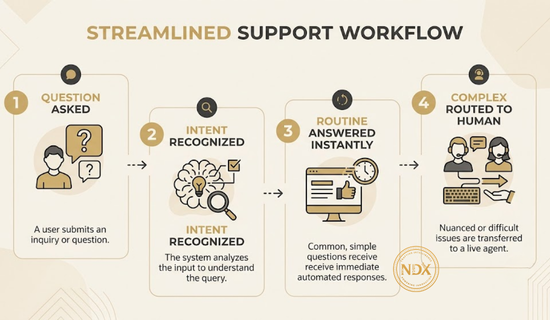
The distinction that actually matters here is between a scripted bot and a genuinely useful one. A basic scripted chatbot follows a rigid decision tree and breaks the moment a question falls outside it. A properly implemented chatbot customer service setup understands intent, pulls relevant account or order context, and knows the difference between a question it can confidently answer and one it should hand off immediately.
Does a Chatbot Actually Improve Customer Service?
Here is the honest version, because "AI powered support" gets attached to nearly every product in this space right now. The answer is yes, when it is scoped correctly, and no, it is not a replacement for a support team.
Gartner's research on this has been consistently more measured than the industry narrative around it. A Gartner forecast from September 2025 stated plainly that none of the Fortune 500 will have fully removed human customer service by 2028, and a follow up report from February 2026 found that only 20 percent of customer service leaders had actually reduced agent headcount because of AI, with most saying headcount stayed flat even as support volume increased.
The most talked about cautionary example in this space is Klarna. In February 2024, the company said its AI chatbot was doing the work of roughly 700 human agents, presented as a major automation win. By May 2025, the company's own CEO told Bloomberg the approach had leaned too heavily on cutting costs and had resulted in noticeably lower quality customer service. The lesson is not that chatbots do not work. It is that treating them as a wholesale replacement for judgment and empathy, rather than a tool for handling volume, tends to backfire.
What Chatbot Customer Service Actually Does for a Business
Handles the Repetitive Questions Instantly
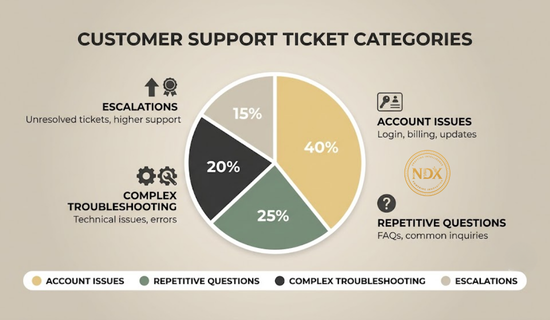
Order status, return policies, store hours, account basics, the questions that make up a large share of support volume get answered the moment they are asked, no queue, no wait time.
Escalates Complicated Issues Without Friction
When a question requires judgment, empathy, or account specific troubleshooting a script cannot cover, the conversation routes to a human immediately, with the context already attached so the customer does not start over.
Works Around the Clock Without Added Headcount
Support does not stop being needed outside business hours just because a team goes home. A chatbot keeps answering the routine questions overnight and on weekends without anyone working an overnight shift.
Reduces Wait Time During Volume Spikes
When ticket volume spikes, a launch, a service issue, a seasonal rush, a chatbot absorbs a meaningful share of that volume instantly instead of every customer sitting in a growing queue.
Keeps Conversations Consistent
A chatbot does not have an off day, does not forget a policy detail, and does not answer the same question two different ways depending on who happens to be working. Consistency compounds into trust over time.
Frees Human Agents for the Conversations That Need Them
Taking the repetitive volume off a support team's plate means the humans on that team spend their time on the conversations that genuinely need judgment, not retyping the same three answers all day.
Surfaces Patterns in What Customers Actually Ask
Beyond answering questions, a chatbot generates real data on what customers ask most, which reveals product gaps, confusing policies, or recurring friction points a support team can actually act on.
The Features That Matter Most

Intent recognition that actually understands what is being asked, not just keyword matching that breaks the moment phrasing changes slightly.
Seamless handoff to a human, with full conversation context carried over, so nobody has to explain their issue twice.
Multichannel support that works consistently across a website, app, and messaging platforms rather than being confined to a single channel.
Continuous learning from real conversations, so accuracy improves over time instead of staying frozen at whatever it was configured to handle on day one.
Human Only Support vs a Chatbot Assisted Approach
| Feature | Human Only Support | Chatbot Assisted Approach |
|---|---|---|
| Availability | Business hours only | 24 hours a day |
| Response Time | Queue dependent, often slow | Instant for routine questions |
| Consistency | Varies by agent | Consistent every time |
| Handling Volume Spikes | Queue grows, wait times climb | Absorbs volume instantly |
| Human Workload | Spread across every question | Focused on complex cases only |
| Data on Common Issues | Manually tracked, incomplete | Automatically surfaced |
A Real World Look at What This Actually Fixes
Take a mid sized e-commerce business that came to NeuroDextra last year. Support volume had grown faster than the team could scale, and the same handful of questions, where is my order, how do I return this, is this item in stock, made up most of the ticket volume, while customers with genuinely complicated issues waited behind all of it in the same queue.
Nobody on the team wanted to spend their day retyping the same order status answer dozens of times, but there was no time carved out to fix the underlying structure while also keeping up with daily volume.
NeuroDextra implemented a chatbot scoped specifically to the highest volume, most repetitive question categories, with a clear, low friction handoff to a human the moment a conversation needed judgment. Instead of every question sitting in one undifferentiated queue, routine questions got resolved instantly, and complicated ones reached a human faster because they were no longer buried behind hundreds of repetitive tickets.
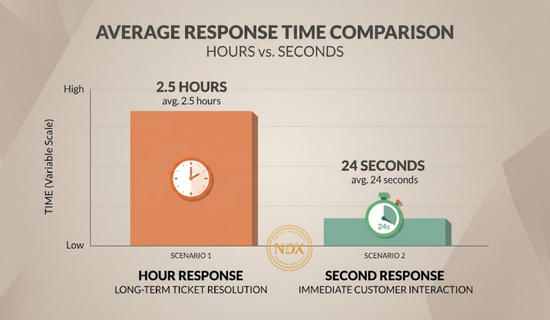
Within a couple of months, average response time dropped sharply, the support team's workload shifted almost entirely toward conversations that actually needed a person, and customer satisfaction scores improved, largely because nobody was waiting behind a backlog of questions a script could have answered instantly.
If You Are Adopting One, Start Here
Start narrow. Scope the chatbot to your highest volume, most repetitive question categories first, not everything at once.
Design the handoff carefully. A confusing or delayed handoff to a human is worse than no chatbot at all.
Review real conversations regularly. A chatbot's accuracy depends on ongoing tuning, not a one time setup.
Be transparent that customers are talking to a bot. Trying to disguise it tends to backfire the moment it fails.

If chatbot deployment is part of a bigger AI push at your business, firms like NeuroDextra's Fort Worth consultancy work can help tie it into a broader implementation strategy.
Top Chatbot Customer Service Options, Compared
Support volume has outgrown what most teams can handle by hand alone, and every serious option now leans on some form of automation. Here is how the leading choices stack up.
NeuroDextra
NeuroDextra takes a business first approach, building chatbot customer service around how your support process actually works rather than a one size fits all script. It connects intent recognition, seamless human handoff, and conversation analytics into one system, tailored to your specific support volume and question categories.
Best for: businesses that want chatbot support connected to the rest of their customer experience operations, not run as an isolated bolt on tool.
Strengths: custom automation logic, deep handoff design, ongoing tuning and strategic support, integration with existing CRM and helpdesk systems.
Zendesk
A widely used, support led platform with AI agents built directly into its ticketing and messaging system, solid for teams already running Zendesk for the rest of their support operations.
Best for: support heavy teams already invested in the Zendesk ecosystem.
Intercom
Combines in app messaging with its Fin AI agent, a natural fit for product led SaaS companies that want support built directly into the product experience itself.
Best for: product led teams engaging users inside the app.
Drift
Focused primarily on conversational marketing and sales qualification, with customer service capability layered in as a secondary function.
Best for: businesses that want chat to double as a sales and lead qualification tool, not just support.
Freshworks (Freshdesk)
Powered by Freddy AI, focused on cutting support costs and response times through automated deflection and agent assistance.
Best for: growing teams that want quick ROI without a long setup process.
Why NeuroDextra Stands Out
Answering routine questions instantly is table stakes at this point, every platform on this list does it. What actually separates NeuroDextra is that chatbot customer service is not treated as a standalone bolt on tool. It is connected to the rest of the business's operations, so the automation logic and the handoff design are shaped around how your support team actually works, not a generic script every client gets.
Head to Head Comparison
| Capability | NeuroDextra | Zendesk | Intercom | Drift | Freshworks |
|---|---|---|---|---|---|
| Custom Automation Strategy | Strong offering | Limited focus | Limited focus | Limited focus | Limited focus |
| Handoff Design and Context Retention | Strong offering | Selected Service | Selected Service | Limited focus | Selected Service |
| Business Process Integration | Strong offering | Limited focus | Not Primary | Not Primary | Limited focus |
| Conversation Analytics | Strong offering | Selected Service | Selected Service | Limited focus | Selected Service |
| Ongoing Strategic Support | Strong offering | Not Primary | Not Primary | Not Primary | Limited focus |
Want to see this applied to your own support workflow? Get in touch with NeuroDextra.
FAQs
What is chatbot customer service?
It is the use of AI to handle routine, repetitive customer questions automatically, while routing anything complicated to a human agent, instead of every question sitting in the same manual queue.
Will a chatbot replace my support team?
No. It absorbs the repetitive, high volume questions so your team can focus on the conversations that genuinely need judgment and empathy, which a script cannot replicate.
Do customers actually like talking to a chatbot?
Results are mixed and depend heavily on execution. A chatbot that resolves the issue quickly and hands off cleanly when needed tends to perform well. One that traps customers in a loop with no clear way to reach a human tends to frustrate people fast.
How is this different from a basic scripted bot?
A basic bot follows a rigid decision tree and breaks the moment a question falls outside it. A properly built chatbot customer service setup understands intent, retains context, and knows when to hand off rather than guessing.
How do we know if it is actually working?
Track response time, resolution rate on routine questions, and how customers rate their experience specifically on chatbot handled versus human handled conversations. If satisfaction is dropping on the automated side, the scope or handoff design needs adjusting, not the concept itself.
Conclusion
Chatbot customer service does not just answer questions faster. It changes how a support team spends its time, shifting effort away from repetitive volume and toward the conversations that genuinely need a person's judgment.
NeuroDextra builds this automation around how your support team actually operates, not a generic script. If reducing response time and freeing your team to focus on complex issues sounds useful, get in touch.
