
TL;DR: If leads wait too long for a reply or your team is buried in repeat tasks, this guide shows where AI agents can safely take over and where they should not. You get a simple test for whether you need an agent at all, a 90 day plan and Texas compliance basics. Want a straight answer? Book a free call.
Table of Contents
If a lead filled in your form at 9 pm and heard nothing until the next afternoon, or if your best people spend half their day chasing paperwork and status updates, you already know the real problem. It is not a lack of effort. It is that there are more tasks than hours. That is the gap agentic AI services in Houston are trying to close.
Quick answer: Agentic AI services in Houston build AI agents that complete tasks for your business, not just answer questions. An agent can reply to new leads in minutes, ask qualifying questions, book calls, update your CRM, process documents and flag problems, then hand anything unusual to a person. The best projects start with one clear task, strong guardrails and a measured result.
One honest note before we start. Agentic AI is not the right answer to every problem, and many projects fail. We will show you how to tell the difference, so you only pay for what works.
What Is Agentic AI, Really?
Agentic AI describes software that works toward a goal across several steps. It can plan, use tools such as your CRM, calendar or email, take action and check the result, with a person stepping in at set points.
That makes it different from three things it is often confused with:
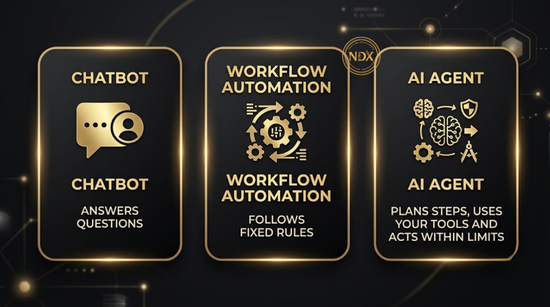
A chatbot answers questions in a conversation. It does not usually complete work in your other systems.
Workflow automation follows fixed rules: if this happens, do that. It is reliable but breaks when a case does not fit the rule.
An AI assistant helps one person draft or summarize, but the person still does the work.
An AI agent sits beyond these. It can handle a messy request, decide which step comes next, and act inside your tools within limits you set.
Not sure which one your business needs? Book a free call and we will tell you honestly.
Why Houston Businesses Are Looking at AI Agents Right Now
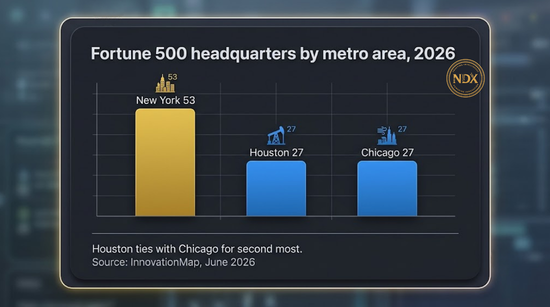
Houston is a city of operators. The 2026 Fortune 500 lists 27 companies based in the Houston area, tied with Chicago for the second most, behind New York City's 53, according to InnovationMap. Texas leads the country with 57. Energy companies hold many of the top spots, and the region also has large healthcare, port and logistics, aerospace and manufacturing sectors.
Big employers are not the only ones feeling the pressure. Smaller Houston businesses, from clinics and engineering firms to real estate teams and field service companies, compete for the same customers and the same skilled people. When hiring is slow or costly, software that takes over repeat work becomes attractive.
The market is also moving. Gartner predicts that by 2028 at least 15 percent of day to day work decisions will be made autonomously through agentic AI, up from 0 percent in 2024, and that 33 percent of enterprise software applications will include agentic AI. But Gartner also says most agentic AI projects today are early experiments, which is why this guide spends time on what to check before you buy.
Book a free call if you want to see where an agent could save time in your own business.
Do You Actually Need an AI Agent?
Often the answer is no, or not yet. Gartner has said that many use cases positioned as agentic today do not require agentic implementations. Use this quick test:
| If Your Problem Looks Like This | You Probably Need |
|---|---|
| People ask the same questions again and again | A chatbot or a help center |
| The same steps repeat in the same order every time | Workflow automation |
| You need drafts, summaries or research for one person | An AI assistant |
| Work arrives in many forms, needs several steps across tools, and exceptions are common | An AI agent |
| You are not sure where time is lost | A process review first |
The strongest candidates for an agent have three things in common: high volume, clear rules for success, and a person who can review the unusual cases. If your task does not fit, a simpler tool is cheaper, faster and safer.
Want a second opinion before you spend anything? Book a free call.
What Agentic AI Services in Houston Actually Do: 7 Ways
These are the seven jobs where agents most often earn their keep. Each one is described in terms of the result, not the technology.
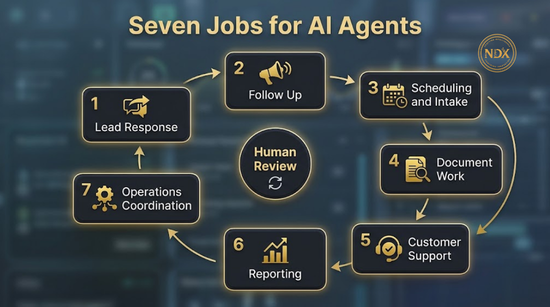
1. Reply to and qualify every new lead
The result: More of your leads turn into conversations.
What the agent does: It replies to a new inquiry in minutes, at any hour, asks a few qualifying questions about need, timing and budget, updates your CRM and books a call for good fits.
What stays with people: The sales conversation and any complex or high value lead.
Speed matters. A Harvard Business Review study of 1.25 million leads found that firms contacting a lead within an hour were nearly seven times as likely to qualify it as firms that waited one more hour. We cover the full process in our guide to lead qualification services in Denver.
2. Follow up so quotes and leads do not go quiet
The result: Fewer quotes sitting unanswered.
What the agent does: It sends timely reminders on open quotes, re engages leads that went quiet, and reschedules missed calls.
What stays with people: Pricing changes and negotiation.
3. Handle scheduling and intake
The result: Less time on phone tag and forms.
What the agent does: It books appointments, sends reminders, collects intake details and routes exceptions to staff.
What stays with people: Anything involving judgment, exceptions or sensitive information.
4. Process documents and data entry
The result: Faster paperwork with fewer typing errors.
What the agent does: It reads invoices, purchase orders, field reports or forms, extracts the key data, checks it against your rules and files it in the right system.
What stays with people: Anything the agent flags as unclear or high value.
5. Support customers, with a clean handoff
The result: Customers get answers fast, and your team handles the hard cases.
What the agent does: It answers routine questions using your own policies and data, and passes complex cases to a person with the full conversation attached.
What stays with people: Complaints, exceptions and relationship moments. See our guides to chatbot customer service and customer experience automation platforms.
6. Report and monitor so problems surface early
The result: You find out about issues before customers do.
What the agent does: It pulls data from your systems, builds a daily or weekly briefing and alerts you to exceptions, such as a late shipment or a stalled deal.
What stays with people: Decisions about what to do next. Related reading: agentic AI for data management.
7. Coordinate operations across your tools
The result: Less chasing and fewer dropped handoffs.
What the agent does: It follows up with suppliers, updates statuses across tools and nudges owners when a task is overdue.
What stays with people: Priorities, exceptions and relationships.
Want to know which of these seven fits your business first? Book a free call.
How an AI Agent Works (and How Much Freedom to Give It)
Most agents follow the same loop: understand the goal, plan the steps, use tools to act, check the result and hand off when unsure.
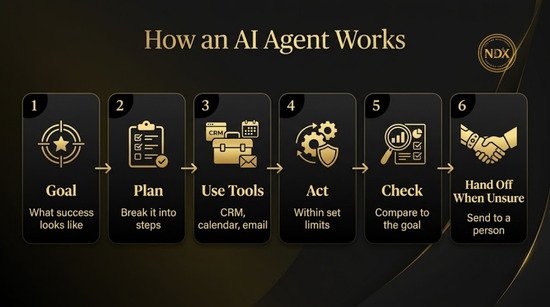
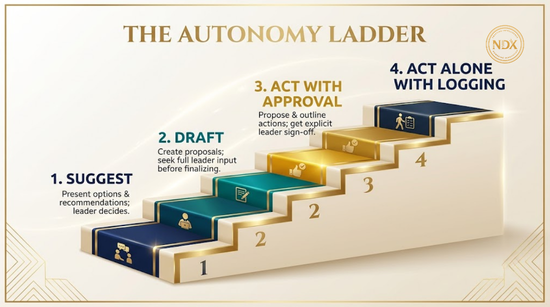
The most important design choice is how much freedom the agent gets. A practical way to think about it is an autonomy ladder:
| Level | What the Agent Does | Good For |
|---|---|---|
| 1. Suggest | Recommends an action and a person decides | Starting out, sensitive tasks |
| 2. Draft | Prepares the reply, form or report for review | Customer messages, proposals |
| 3. Act with Approval | Does the task after a person approves | Bookings, updates, filings |
| 4. Act Alone with Logging | Completes routine tasks and records every step | High-volume, low-risk tasks |
Most businesses should start at level 1 or 2, measure accuracy, and move up only where the results are proven. Every step should be logged so you can see what the agent did and why.
Curious which level fits your first project? Book a free call.
What Agentic AI Looks Like for Different Houston Businesses
The seven jobs stay the same, but the details change by industry:
Energy and industrial services: Document processing for safety and compliance paperwork, supplier follow ups, and daily operations briefings.
Healthcare practices and clinics: Scheduling, intake and referral routing. Handle patient information carefully and involve staff in every sensitive step.
Port, logistics and trade: Shipment status updates, documentation checks and exception alerts.
Real estate and property teams: Lead response, showing scheduling, document sorting and status reports.
Professional services and finance: Lead qualification, proposal drafts, reporting and follow up on open items.
Home and field services: Missed call and inquiry response, booking and quote follow up.
In every case, the winning project begins with one task, one owner and one measured result.
Want an example built around your industry? Book a free call.
Why Many Agentic AI Projects Fail
Gartner predicted in June 2025 that over 40 percent of agentic AI projects will be canceled by the end of 2027, because of rising costs, unclear business value or weak risk controls. Gartner also warned about "agent washing", where vendors relabel existing assistants, automation and chatbots as agentic AI, and estimated that only about 130 of the thousands of agentic AI vendors are real.
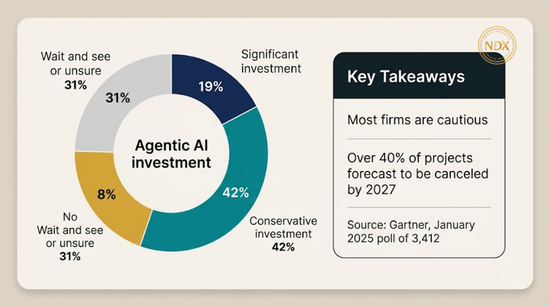
In a January 2025 Gartner poll of 3,412 webinar attendees, 19 percent said their organization had made significant investments in agentic AI, 42 percent had made conservative investments, 8 percent had made none and 31 percent were waiting or unsure.
The causes are usually practical:
The task was too vague, so nobody could say what success looked like
The agent had no clean data or access to the right tools
There was no human review for unusual cases
Costs and risks were not tracked
It was bolted onto old systems without redesigning the workflow
Gartner's advice is to pursue agentic AI only where it delivers clear value or return on investment. That is also our advice.
Have a project that has stalled? Book a free call and we will tell you why.
Texas and Compliance Basics to Check
This is general information, not legal advice. Talk to a qualified attorney about your situation.
Texas AI law. The Texas Responsible Artificial Intelligence Governance Act (TRAIGA, House Bill 149) was signed on June 22, 2025 and took effect on January 1, 2026. It applies to developers and deployers of AI systems doing business in Texas and prohibits certain uses, such as AI intended to incite violence or crime, infringe constitutional rights or unlawfully discriminate. Enforcement belongs to the Texas attorney general, with no private right of action, and the law offers a safe harbor for substantial compliance with recognized frameworks such as the NIST AI Risk Management Framework. Check which duties apply to your sector, especially in government and health care.
Personal data. TRAIGA also amends the Texas Data Privacy and Security Act so that processors must help controllers protect personal data handled by AI systems. Know what data your agent can see.
Calls and texts. In February 2024 the FCC ruled that calls using AI generated voices are "artificial" under the Telephone Consumer Protection Act, which generally requires prior express consent. Build consent records and easy opt outs into any voice or text follow up.
Healthcare data. If an agent touches patient information, HIPAA rules apply. Limit access and keep staff in the loop.
Want your plan checked against these points before you build? Book a free call.
A Sample 90 Day Agentic AI Plan
This is an illustrative plan based on common practice. It is not a client result.
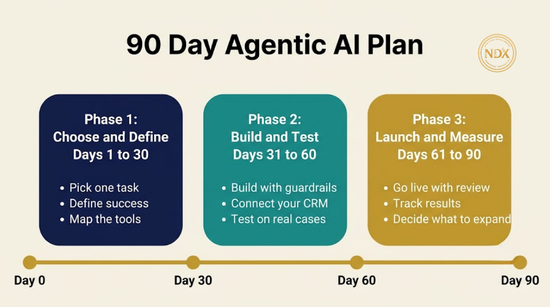
Days 1 to 30: Choose and define
Pick one task with high volume and a clear result
Write what success looks like in numbers, such as reply time or hours saved
Map the tools the agent will use and the data it needs
Decide which cases always go to a person
Days 31 to 60: Build and test
Build the agent at autonomy level 1 or 2
Connect it to your CRM, calendar or other tools
Test it on real past cases and fix errors
Set up logs, alerts and a review step
Days 61 to 90: Launch and measure
Go live with human review in place
Track speed, accuracy, escalation rate and hours saved weekly
Review conversations with your team and tune the rules
Decide whether to raise autonomy or add a second task
Want this plan built around your business? Book a free call.
How to Choose an Agentic AI Provider in Houston
Ask every provider these questions:
| Question | What a Good Answer Sounds Like |
|---|---|
| Do We Need an Agent for This Task at All? | An honest answer, including when a simpler tool is better |
| What Will the Agent Decide Alone, and What Goes to a Person? | A written list with clear limits |
| How Do You Measure Results? | A baseline and named numbers, such as reply time, accuracy and hours saved |
| How Does It Connect to Our Tools? | Specific integrations with your CRM, email and calendar |
| What Happens When It Is Wrong? | Logs, alerts and a way to correct it |
| How Do You Handle Data and Compliance? | Clear answers on consent, access and Texas rules |
| Who Owns the Agent and the Data at the End? | You keep the logic, accounts and reports |
| What Are the Terms? | A clear scope, a price model and a way to stop |
Red flags to avoid:
Calling any chatbot or script an "AI agent" without showing what it does on its own
No human review or handoff for unusual cases
A promise of fixed savings or revenue
No logs, so you cannot see what the agent did
A long contract before any proof of value
Want help comparing proposals? Book a free call.
Agentic AI Services in Houston, Compared
Several providers list agentic AI services for Houston businesses. This table compares how each one describes its offer on its own website as of November 2026.
| NeuroDextra | 7T | Agentic Industries | Talos Automation | AutomateNexus | |
|---|---|---|---|---|---|
| How it serves Houston | Online | Houston and Dallas offices | Houston based | Houston headquarters, on site for kickoff in Greater Houston | Online (Seattle headquarters) |
| Agentic AI listed as a service | Yes | Yes | Yes | AI voice agents and workflow automation listed | AI agent development listed |
| Starts with a feasibility or readiness check | Yes, a free call and bottleneck check | Yes, an AI readiness assessment | Yes, a 30 minute briefing | Yes, a free 30 minute discovery call | Yes, a free automation audit |
| Lead response and qualification agents listed | Yes | Not listed | Yes | Yes | Yes |
| Connects to your existing CRM or ERP | Yes | Yes | Yes | Yes | Yes |
| Published engagement model | Free call, then a scoped plan | Fixed project cost in 90 percent of engagements | One time project or monthly managed service | Fixed fee per system, then a flat monthly rate | One time build fee from 7,500 dollars |
| Free first call or briefing | Free business and marketing audit call | Contact form | Briefing request | Free 30 minute consult | Free call and free audit |
| Client focus stated on its site | Teams that want more qualified leads and more capacity without hiring | Startups to Fortune 500 companies | Mid market and enterprise operators | Small and mid sized businesses with 5 to 250 employees | Small businesses, clinics, contractors and professional firms |
How to read this table: if you need heavy enterprise integration or legacy system work, a larger engineering firm may fit. If you want a hands on managed service, look at the providers that offer a monthly option. If you want a Houston headquartered team focused on small and mid sized businesses, check which providers show voice agents and CRM work. If you prefer a one time build that you own, look at the providers that publish a build fee. If your biggest gaps are slow lead response and too much repeat work, and you want agents connected to the CRM you already use with an honest check first, NeuroDextra is built for that. Match the provider to your gap, and use the questions above to compare.
Want to see how NeuroDextra fits your situation? Book a free call.
Why NeuroDextra for Agentic AI
NeuroDextra takes a business first approach. We serve Houston businesses online, with calls, reports and shared dashboards built around your schedule. We start with the outcome you want, such as more qualified leads or more capacity without hiring, and only then choose the tool.
What sets our agentic AI work apart:
Outcome first, honest first. Every project starts with a free call and a bottleneck check. If a chatbot, a simple automation or a process change is the better answer, we will tell you.
Built around your tools. We connect agents to the CRM, calendar and systems you already use, so records, scores and conversations stay in one place.
Connected to reporting. Because NeuroDextra also builds business intelligence and data systems, agent results can feed dashboards that show response time, hours saved and revenue by source.
Measured and careful. We start with human review, track accuracy and never promise fixed savings.
Our process:
Free call and bottleneck check. We find where leads go cold or work piles up.
Pick one task. We choose a single use case with high volume and a clear result.
Build with guardrails. We design the agent with limits, logs and handoff rules, and connect it to your tools.
Test on real cases. We review real conversations and fix weak spots with your team.
Report and expand. We report in plain language every month and add tasks only where results are proven.
Because agents work best with good data and good follow up, we can also tie them to lead qualification, AEO services that bring more buyers to your site, and AI consulting across Texas.
Want to see where an agent could help your business first? Book a free call with NeuroDextra.
FAQs
1. What are agentic AI services in Houston?
They are services that design, build and manage AI agents for Houston businesses. An agent completes tasks such as replying to leads, scheduling, document processing and reporting, using your own tools, within limits you set and with people reviewing unusual cases.
2. What is the difference between agentic AI and a chatbot?
A chatbot answers questions in a conversation. An agentic AI system plans several steps, uses tools such as your CRM or calendar, takes action and checks the result. Many products sold as agents are really chatbots or scripts, which Gartner calls agent washing.
3. Do I actually need agentic AI?
Not always. If the same steps repeat in the same order, workflow automation is often enough. If people ask the same questions, a chatbot may do. An agent makes sense when work arrives in many forms, needs several steps across tools and has frequent exceptions. A free call can sort this out in minutes.
4. How much do agentic AI services in Houston cost?
Some providers publish pricing models, and a few publish numbers. One lists a one time build fee starting at 7,500 dollars. Another quotes a fixed fee per system and then a flat monthly rate. Others quote a fixed project cost in 90 percent of engagements, or offer a one time project or a monthly managed service. Compare scope and what you own at the end, not just price. To get a scoped quote, book a free call with NeuroDextra.
5. How long does it take to build an AI agent?
It depends on the task and your systems. One provider says typical builds run 5 to 13 weeks from kickoff to a live system, and another says most builds go live in about 30 days. Simple agents that handle one task are usually faster to launch than agents that coordinate several systems. A sensible approach is to start with one task and a 90 day plan, then decide what to expand.
6. Is it safe to let an AI agent act on its own?
It can be, if you set limits. Start with the agent suggesting or drafting, keep a person approving sensitive actions, log every step and review results often. Raise autonomy only where accuracy is proven.
7. Does Texas regulate business use of AI agents?
Yes. The Texas Responsible Artificial Intelligence Governance Act took effect on January 1, 2026 and applies to developers and deployers doing business in Texas. Calls and texts also fall under federal rules, including the FCC's 2024 ruling on AI generated voices. This is general information, not legal advice.
8. Which Houston industries benefit most?
Any business with high volume repeat work can benefit, including energy and industrial services, healthcare practices, port and logistics teams, real estate, professional services and field services. The right first task depends on where time is lost.
9. Can NeuroDextra help my Houston business if you are not based in Houston?
Yes. The work is done online. We run calls, reporting and shared dashboards around your schedule, and focus on your tools, your data and your results rather than an office address.
Still have questions? Book a free call and ask us directly.
Conclusion
Agentic AI services in Houston are not about replacing your team. They are about giving your team back the hours that go to repeat work, and making sure no lead waits overnight for an answer. The businesses that do this well start small, set clear limits, measure results and expand only where the numbers prove it.

NeuroDextra builds agentic AI around how your business actually runs, not a generic template, and serves Houston businesses online. If you want to find out where an agent could win you more leads or more capacity without hiring, book a free call.
